Predictive AI for Life-Saving Sepsis Intervention
A hospital-grade Medical Device Software (MDSW) for clinical decision support integrating the Sepsis Prediction Index (SPI®) to identify sepsis risk up to 48 hours before clinical signs appear, enabling timely, life-saving intervention.
Problem
Every 2.8 seconds, someone dies from sepsis.
Most Cases Are Detected Too Late.
⁶ CDC
System
VIOSync SPI® Overview
VIOSync SPI® processes clinical variables, including vital signs, laboratory results, demographics, and comorbidities and was trained on over 22,000 unique patient episodes, with independent validation on more than 5,500 unique patients.
Data In
Secure and seamless data ingestion from EHRs, ensuring standards- based connectivity (HL7/FHIR)
Digital Patient Twin
Continuous modelling of the patient’s physiology to precisely track and detect the most subtle, early changes in status.
Sepsis Prediction Index
Our explainable AI engine generates a dynamic, validated risk score up to 48h before clinical signs are present.
Explainability Output
Presents the top contributing clinical variables to the current SPI® score, with direction, magnitude, and the most recent input values, to support clinician interpretation of the risk estimate.
Features
What Clinicians Get with VIOSync SPI®
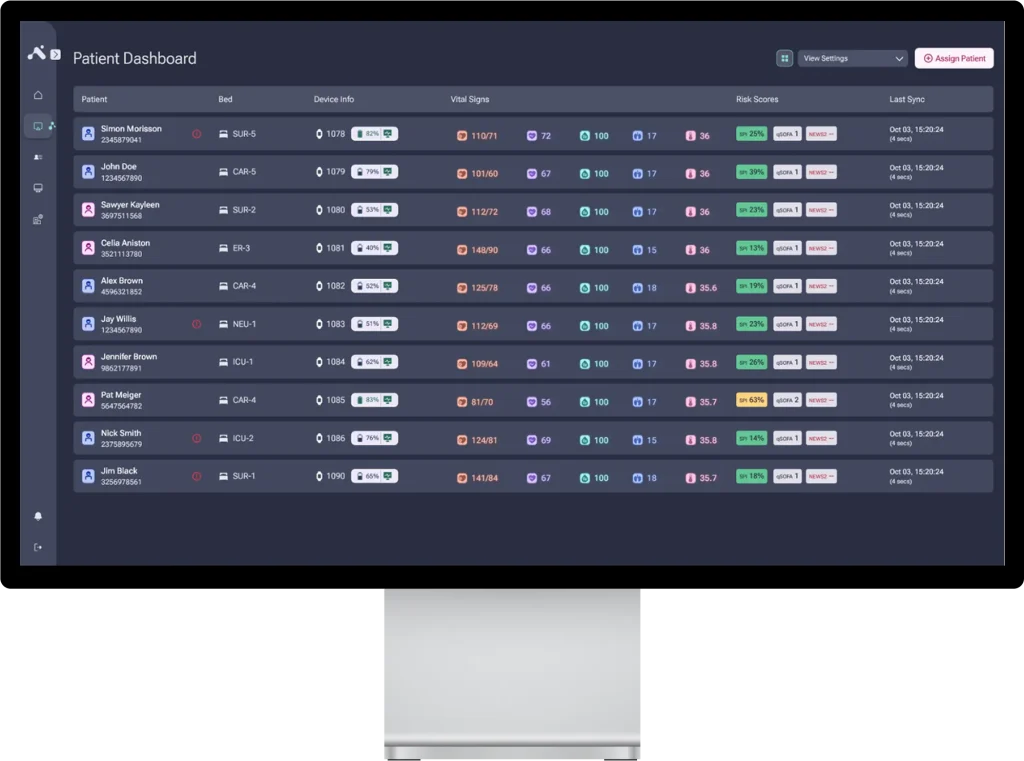
Real-time risk & trend visualisation
Patient and ward-level visualisation, enabling rapid triage decision-making with trajectories and change-points.
Validated Safety & Compliance
Developed as a Class IIa Medical Device Software under an ISO 13485-certified QMS, with risk management per ISO 14971 and software lifecycle processes compliant with IEC 62304
Transparent rationale panel
Clinician-readable “why this score” with contributing factors.
Time-aware detection
Recognises when a patient’s state is changing—hours before signs.
Multi-patient triage dashboard
Sort and filter by risk score, new alerts, or overdue actions to prioritise care across the entire ward
Deployment flexibility
Accessible either as a standalone web-based application within the hospital's secure IT environment or as an embedded module within the hospital EHR. Both configurations operate under the same algorithmic logic, outputs, and intended purpose.
Impact
Clinical & Operational Impact
Early identification of sepsis leads to faster intervention, better outcomes, and significant cost savings.
Reduced In-Hospital Mortality
Earlier clinical intervention is associated with improved survival outcomes in sepsis. Published evidence indicates that sepsis-related mortality decreases by 18-39% ⁽¹⁾ ⁽²⁾ through timely, accurate detection. VIOSync SPI®’s post-market clinical follow-up programme will evaluate real-world clinical impact in line with EU MDR requirements.
Shorter Length of Stay (LOS)
Published evidence indicates that earlier sepsis detection may reduce patient Length of Stay by up to 32.3% ⁽²⁾, improving bed flow and capacity. VIOSync SPI®’s post-market clinical follow-up programme will evaluate real-world clinical impact in line with EU MDR requirements.
Fewer ICU Transfers
Proactive ward-level care supports earlier intervention. Published evidence in AI-assisted sepsis detection demonstrates reductions of 5% in preventable ICU admissions ⁽¹⁾. VIOSync SPI®’s post-market clinical follow-up programme will evaluate real-world clinical impact in line with EU MDR requirements.
Operational Cost Savings
Reduced mortality, fewer ICU days, and shorter overall LOS drive material financial impact. Economic models show potential annual savings of up to £2.5M in a mid-size hospital. VIOSync SPI®’s post-market clinical follow-up programme will evaluate real-world financial impact in line with EU MDR requirements.
Calculator
Quantify the Impact
Estimate your hospital’s potential savings with our interactive ROI Calculator. Adjust your admissions and sepsis caseload to see live projections of reduced ICU stays, shorter ward LOS, fewer readmissions, and total annual cost savings with VIOSync SPI®
- Burdick, H. et al. (2020) BMJ Health Care Informatics
- Adams, R. et al. (2022) Nature Medicine
- Shankar-Hari, M., Harrison, D. A., Rowan, K. M. (2016) Critical Care Medicine
- Hex, N., Retzler, J., Bartlett, C., Arber, M. (2017) The Cost of Sepsis Care in the UK
- Henry, K. E. et al. (2022) Nature Medicine
- Mouncey, P. R. et al. (2015) Health Technology Assessment
Safety
Compliance, Safety and AI Governance
VIOSync SPI® is a Class IIa Medical Device Software (MDSW) under EU MDR (EU) 2017/745, developed under an ISO 13485-certified Quality Management System.
Software lifecycle processes comply with IEC 62304, usability engineering is conducted in accordance with IEC 62366-1, and risk management is performed under ISO 14971.
CE MDR conformity assessment is in progress. Data handling is aligned with GDPR and applicable data protection standards.
The device is not yet CE-marked or placed on the EU market.


FAQ
Does VIOSync replace clinical judgement or existing screening tools?
No. VIOSync is clinical decision support. It surfaces risk earlier and explains why; clinicians remain the decision-makers and continue using local screening/protocols.
How early is it—and how reliable?
SPI® can flag risk hours to ~48h before overt signs in pilots. Site-specific AUROC/PPV/NPV, timeliness, and drift are monitored and reviewed via governance dashboards.
What do clinicians actually see?
A risk score with trend, confidence interval, and an explainability” panel (key contributors).
Will this increase alert fatigue?
We use risk score bands. Thresholds are tuned with a calibration dataset based on each hospital patient population to a target the same validated precision/recall; drift burden is monitored continuously.
Where does it work—only ICU?
Can we tune risk band thresholds?
Yes. Risk band thresholds tuning is a necessary safety step as part of our calibration procedure for each deployment.
What EPRs/EHRs and data do you integrate with?
How is it deployed and where is data stored?
Your choice: SaaS (VPC), hybrid bridge, or on-prem (containerised). Data residency options; encryption in transit/at rest, SSO (SAML/OIDC), RBAC, audit trails.
How do you handle bias, drift, and updates?
Subgroup checks (age/sex/comorbidity/site), calibration/drift monitoring, documented mitigations, versioned releases with rollback, and site-specific re-tuning through governance.
Are there financial benefits to Trusts?
Yes. Pilots and economic models indicate fewer ICU transfers, shorter LOS, and reduced complications, driving material net savings. We provide a site-specific ROI model during evaluation (see Evidence for figures).
How do you measure success and ROI?
Joint KPIs: time-to-recognition, timeliness of interventions, LOS, ICU transfers, mortality (where appropriate), alert burden, and economic impact—reviewed with your governance team.